






Confidence. It’s one of those things we all want more of, but we are rarely taught how it actually works or how to build confidence in real life.
We tend to think confidence means being fearless, outspoken, or naturally charismatic. But that is not true confidence, that is the highlight reel. Real self-confidence is quieter, deeper. And it starts in your brain and nervous system.
In this post, I want to take you under the surface. We are going beyond the motivational fluff and into what neuroscience and the subconscious mind tell us about confidence; how it works, why it matters, and how you can actually build confidence faster (even if you have struggled for years).
What Is Confidence, Really?
Firstly, let’s get address the myth that the most confident person in the room is the loudest or the most cocky. It’s definitely not.
Confidence is an inner sense of safety and self-trust that makes you believe that you can handle whatever happens because you trust yourself.
🧠 The neuroscience bit: how confidence works in the brain
Confidence can be understood as a combination of neurochemical activity and cognitive interpretation in the brain.
It occurs when systems involved in motivation and emotional regulation (such as those influenced by neurotransmitters like dopamine and serotonin) are functioning in balance, and when the prefrontal cortex (the brain’s decision-making and planning centre) assesses a situation as manageable.
When your brain perceives that you are capable of handling the outcome, top-down regulation from the prefrontal cortex helps calm activity in the amygdala, your brain’s alarm system. This reduces the brain’s stress response, creating the conditions for clearer thinking, steadier emotions, and purposeful action.
This is experienced subjectively as confidence.
To be clear, confidence doesn’t mean that you are not scared or have no fear. It means your self-trust is strong enough that you can take action anyway, because you are backed by the belief that you will be able to handle whatever happens next.

💡Try this now: Confidence Reframe Exercise
When you feel nervous or stuck, ask yourself:
‘What would I do right now if I knew I could handle the outcome, no matter what?’
This switches you from survival brain to growth brain.
It goes from ‘What if I mess it up?’ to ‘Whatever happens, I’ve got me.’
This is a great start for confidence.
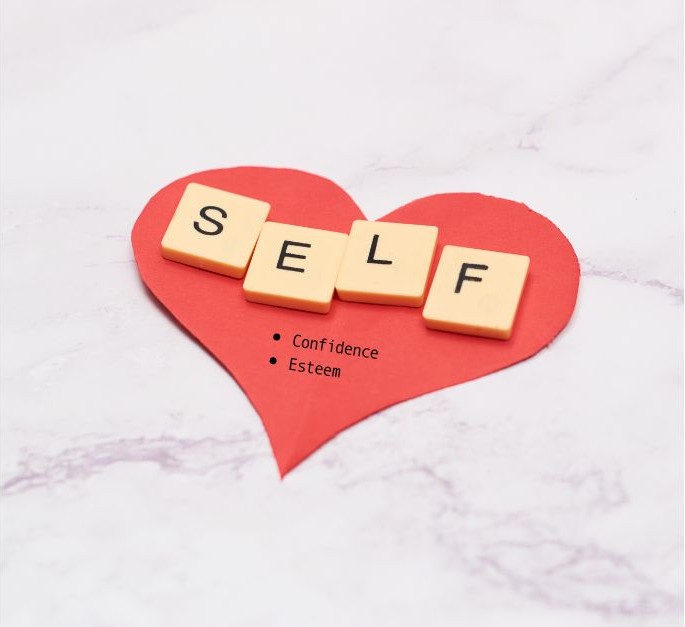
Self-Confidence vs. Self-Esteem
These two concepts are often used interchangeably, but they are not the same.
- Self-confidence is your belief in your ability to do and/or handle something.
- Self-esteem is how much you value yourself, your self-worth.
You can be confident in your work and still struggle with low self-esteem. Or you can love yourself deeply but feel shaky trying something new.
However, working on one usually boosts the other, because both are rooted in the same subconscious beliefs and stories you carry about who you are and what you are capable of.
Think You Can’t Change? Neuroplasticity Proves You Can
🧠 The subconscious angle on building confidence
By age 7, your brain has absorbed thousands of messages, about your worth, your potential, your limits. These form the basis of your identity and shape to a great extent how confident (or not) you feel as an adult.
However:
You can rewire those beliefs. You can teach your brain a new story any time, at any age. Confidence can be learned.
For a long time, it was believed that the brain was fixed, that by adulthood, its structure and abilities were set in stone. But since the 1980s, advances in neuroscience have proven otherwise: the brain remains plastic (changeable), meaning it can adapt, rewire, and grow throughout life, reshaping not only how we think, but who we become. This is called neuroplasticity.
This reshaping happens through focused, repeated action. Every time you respond differently, practice a new thought, or take even a small step outside your usual pattern, you are literally rewiring your brain for self-trust and building confidence.
🛠️ Tool: The Confidence Identity Statement
Write this sentence down and fill in the blanks:
‘I am the kind of person who _______ because I know _______.’
For example:
‘I am the kind of person who speaks up in meetings because I know my ideas matter.’
This is great at creating identity-level change, which is the most powerful form of transformation and confidence-building. You are not just doing confident things. You are becoming a confident person.
Repeat it daily. Your brain will begin to believe you.

Why Confidence Matters in Everyday Life
Confidence is the building block for everything. Without it, even the things you do know or can do won’t land the same way. Research consistently shows that confident people are more likely to:
- Earn more money
- Take more risks (the good kind)
- Build stronger relationships
- Recover from setbacks faster
- Have better physical and mental health
But beyond the research, here’s why confidence matters:
- It gives you access to your full self. Your ideas. Your voice. Your energy. Your drive.
- Without confidence, so much of what makes you you stays hidden behind hesitation and second-guessing.
- It gives you momentum. When you believe in yourself, you are more likely to start, and starting is what gets you unstuck.
Often, what we call ‘lack of confidence’ is an overactive survival system.
Think about it:
- You might think you are holding back because you are lazy, when it is actually because your brain thinks it’s protecting you
- You procrastinate not because you don’t care, but because the fear of failure feels unsafe.
- You shrink in meetings because your subconscious says ‘Don’t risk it’; it has nothing to do with your ability.
So you can stop blaming yourself and start retraining your brain for confidence.
🧠 Neuroscience Tool: The Action-Equals-Safety Reset
Every time you take action, especially when it feels uncomfortable, say to yourself:
“I did it. I showed up and I handled it.”
Whether it went well or not doesn’t matter as much as the fact that you moved forward.
Why? Because your brain builds confidence by linking action to self-trust, rather than perfection.
Even if things felt messy or didn’t go to plan, you took the step. You stayed with it. You proved to your brain that discomfort doesn’t put you in danger and that it actually helps you grow. And that’s what rewires your confidence.
Immediate Ways to Start Building Confidence Today
Ready to Build Confidence? Start Here. These are some brain-based confidence tools you can start using right now:
✅ 1. The Daily Win List
Every evening, write down 3 things you did well, no matter how small.
This helps your brain encode success and action and focuses on what you can do, rather than your mistakes and shortcomings.
✅ 2. Anchor a Confident State
Close your eyes. Think of a time you felt powerful or proud.
Feel it in your body. Now press your thumb and finger together.
Repeat this daily to anchor that confident state.
Use it before interviews, calls, or any moment you need a boost.
✅ 3. Interrupt the Inner Critic
Your inner critic thrives on autopilot. Next time it says, ‘You can’t’, change it to:
‘That’s an old story. I am choosing to believe I can’
Interrupt the loop. Create space for something new and for your confidence to grow.
Confidence Is a Skill, Not a Trait
Regardless of how confident you feel right now, you can build it and grow it, day by day, choice by choice. You don’t even have to feel ready, you just have to feel willing. Willing to show up, to try and to fail and keep going.
Your brain is always listening. And it is ready to believe in something new.






SHARE WITH A FRIEND